
How to Roast a Whole Chicken: Buying, Timing, Safe Temperature and Storage (UK Guide)
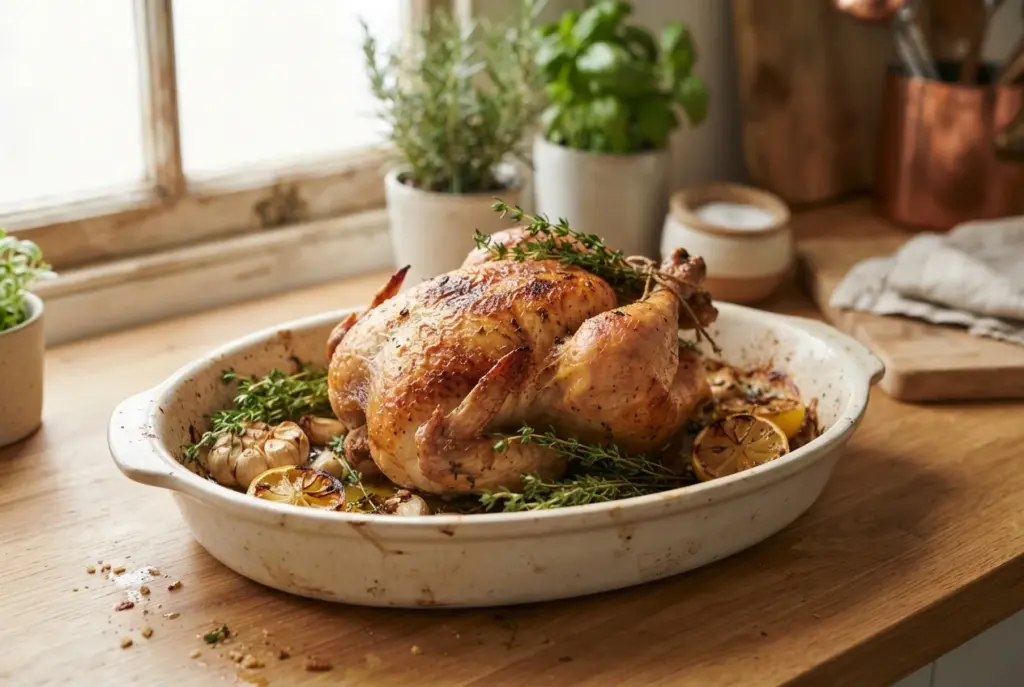
Table of Contents
This post may contain affiliate links. As an Amazon Associate we earn from qualifying purchases.
A whole chicken is done and safe to eat when the thickest part of the thigh reaches the temperatures shown below. See the table in Step 5 for exact readings. Either way, the juices should run clear and the meat should show no pink. Plan on about 1.5 to 2 hours total, including rest time, for a medium bird. This guide covers everything for UK home cooks: what size bird to buy, how to roast one, two faster methods when speed matters, common mistakes, and storing leftovers.
Before You Start: Buying, Sizing and Prep
What “medium”, “large” and “extra-large” actually mean
UK supermarkets, Tesco included, band whole chickens by weight in standardised ranges. Size labels are just guides; the label weight is what determines your cooking time. Price mainly tracks the tier — standard, higher-welfare, or loyalty-card offer.
| Size | Weight range | Typical price |
|---|---|---|
| Medium | 1.2–1.7kg | £2.70–£4.80/kg |
| Large | 1.5–2.1kg | £2.70–£4.80/kg |
| Extra Large | 1.9–2.3kg | £2.70–£4.80/kg |
Check the label weight for your actual bird when planning your roast.
How many people it feeds
How much you need scales with the bird’s weight, and how many sides are on the table. Use the guide below, then check the label weight for your actual bird.
| Bird | Feeds |
|---|---|
| Raw chicken per person (main course, with 2-3 sides) | 225g |
| Raw chicken per person (chicken is the only protein) | up to 450g |
| Medium bird (~1.4kg) | Four people |
| Large bird (1.8–2kg) | Five or six, usually with leftovers |
What you actually need
- A roasting tin large enough that the bird isn’t touching the sides
- A trivet or rack, which lifts the bird out of its own fat and helps the underside crisp (optional, though recommended)
- A meat thermometer, the one piece of kit that stops you guessing
- Kitchen string, only if you want to tie the legs together
Prep before it goes anywhere near the oven
Take the chicken out of the fridge 30-60 minutes ahead if you have the time, so it isn’t starting from stone cold. Pat the skin dry with kitchen paper — dry skin browns; moisture steams. Check inside the cavity for the giblets bag and pull it out before you do anything else. If you’re organised the day before, salt the bird and leave it uncovered in the fridge overnight. It dries the skin further and seasons the meat right through, past the surface.
If you’re planning a full Sunday roast around the chicken, with potatoes, veg and gravy all landing hot at the same moment, our Sunday Roast Timing Cheat Sheet works backward from your serving time so nothing sits cooling on the side while something else finishes.
Method 1: How to Roast a Whole Chicken (Step by Step)
Step 1: Prep the Bird
Pat the skin dry again just before cooking, even if you already did it earlier. Rub the whole bird, including under the skin at the breast where you can slide a finger in, with a couple of tablespoons of softened butter or oil. Season generously with salt and pepper, inside the cavity as well as out. This preparation is the single step that decides how the skin turns out.
Step 2: Season and Fill the Cavity
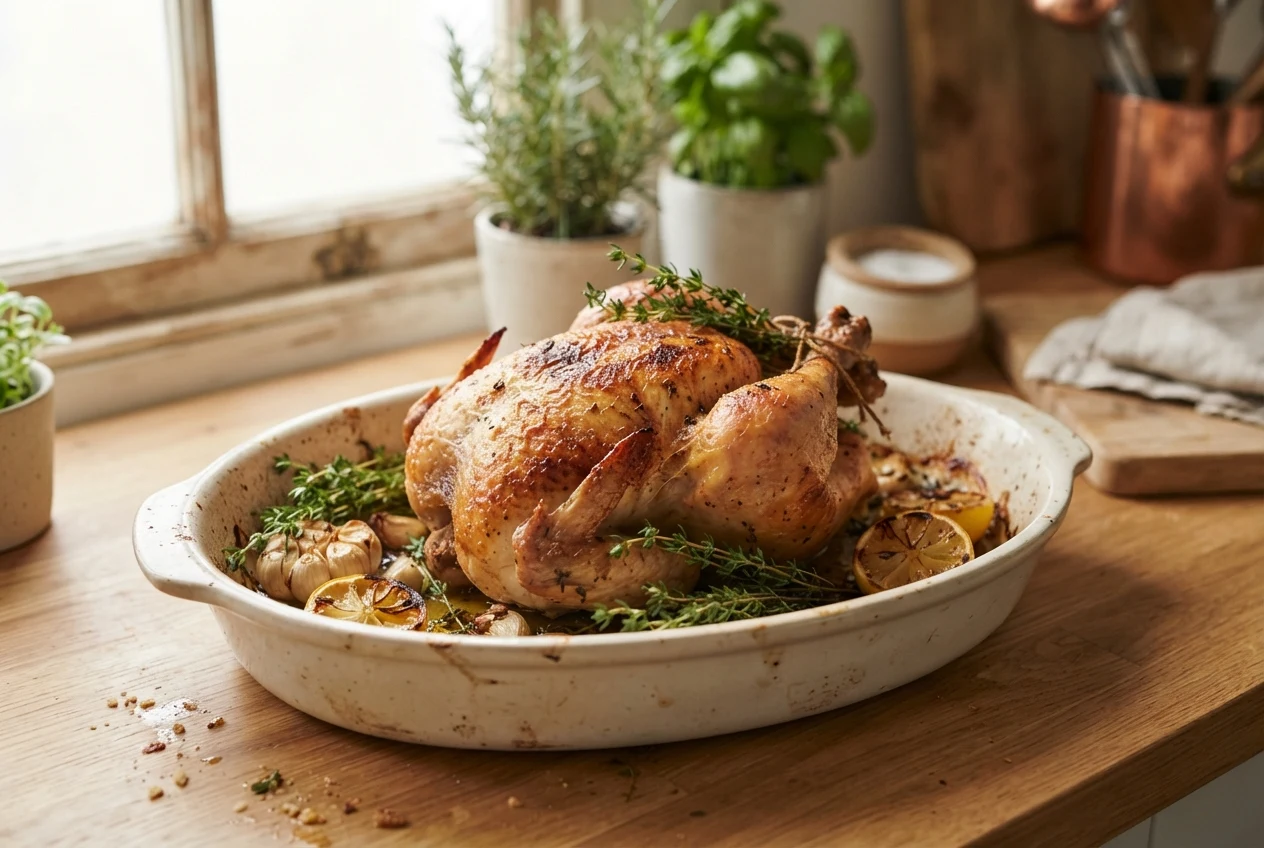
Half a lemon, a bulb of garlic cut through its equator, and whatever woody herbs you have to hand (thyme, rosemary, a bay leaf or two) go into the cavity. They steam gently as the bird cooks and flavour the pan juices you’ll turn into gravy. Don’t pack the cavity tight; air needs room to move through it for even cooking.
Step 3: Get It Into the Oven
Set the oven to 190°C (375°F), fan or conventional, and sit the chicken breast-side up in the tin, on a trivet if you have one. Middle shelf, nothing directly above it blocking the airflow.
Step 4: Follow the Roasting Time Chart
Time gets you close; use these figures as a starting point for checking. These timings are for an unstuffed bird at that temperature (set in Step 3):
| Chicken weight | Roasting time (hours:mins) |
|---|---|
| 1-1.5kg (2.2-3.3lb) | 1h to 1h45m |
| 1.5-2kg (3.3-4.4lb) | 1h30m to 1h45m |
| 2-2.5kg (4.4-5.5lb) | 1h30m to 2h |
| 2.5-3kg (5.5-6.6lb) | 1h45m to 2h30m |
Add 15-20 minutes if the cavity is stuffed; start checking the temperature from the low end of the range to avoid overcooking.
Step 5: Check It’s Actually Done
Don’t stop at the timer. Push a meat thermometer into the thickest part of the thigh, close to the bone but not touching it, since that’s the last part to cook through.
| Safe minimum reading | Method |
|---|---|
| UK: 70°C held 2 min (or instant 75-80°C) | meat thermometer in thigh |
| US: 165°F (74°C) | meat thermometer in thigh, wing, breast |
These readings mark the UK Food Standards Agency’s safe minimum for poultry. Without a thermometer, cut into the thigh at its thickest point. Juices should run completely clear, and the meat should show no pink. Cooking beyond these temperatures affects texture alone, not food safety.
Step 6: Rest It
Move the chicken to a board or a warm plate, tent it loosely with foil, and leave it for 15-20 minutes before carving. The meat reabsorbs its juices during this rest, keeping them through the carving.
Step 7: Carve It
Start with the legs. Cut through the skin between the leg and the body, then push the leg outward until the joint pops and slice through it. Wings come off the same way. For the breast, cut down either side of the breastbone and lift each half off in one piece before slicing it across.
Method 2: Other Ways to Cook a Whole Chicken
Spatchcocking: Faster and More Even Browning
Cut out the backbone with kitchen scissors and press the bird flat. Heat reaches the thigh and breast at close to the same rate, so roasting time drops and the skin browns evenly across the whole bird. It’s the method I reach for on a weeknight, or when the oven’s already busy with sides.
Slow Cooker: Hands-Off, Soft Skin Trade-Off
A whole chicken in a slow cooker on low for several hours comes out fall-apart tender with almost no attention, ideal if you’re out of the house all day. The skin steams inside the pot and stays pale and soft, which suits shredded dishes perfectly. For shredded chicken in sauces or curries, this method delivers tender, flavourful meat. A thin, bland sauce after hours of slow cooking points to specific fixable issues; our guide to fixing a bland, watery slow cooker covers them.
Pressure Cooker: Fastest, Soft Skin
A pressure cooker gets a whole chicken cooked through in well under an hour, the fastest method of all. The sealed pot steams the skin, leaving it pale and soft. This excels for shredded dishes, soups, and casseroles where tender meat matters most. For a golden, crispy finish, traditional roasting works better.
What Doesn’t Work
- Don’t wash raw chicken before cooking. The Food Standards Agency advises against it: rinsing splashes bacteria-laden water across your sink, taps and worktop. Thorough cooking destroys the bacteria far more effectively than a rinse under the tap.
- Don’t cook straight from frozen. A frozen bird cooks unevenly; the exterior may appear cooked while the interior stays in the danger zone for bacterial growth. Thaw it fully in the fridge before it goes anywhere near the oven.
- Don’t judge doneness by colour or time alone. Visual checks are unreliable. Pink can appear in fully safe birds, and pale meat can hide underdone cores. A meat thermometer is the only reliable way to check doneness.
- Don’t aim for 180°F (83°C) for safety. This came from an older version of this guide. The UK minimum is 70°C for 2 minutes, the US minimum is 165°F (74°C); cooking beyond those temperatures affects only texture, not food safety. Excess heat dries the breast without improving doneness.
Tips for a Better Roast
- Crispier skin. Dry the skin thoroughly, leave it uncovered in the fridge overnight if you can plan ahead, and rub with a little extra fat right before it goes in. Dry skin browns and crisps in the oven; excess moisture steams away the colour.
- Gravy from the tin. Pour off most of the fat, leave the browned bits and juices behind, whisk flour into the fat that’s left, cook it out for a minute, then stir in stock a little at a time. That’s British gravy, no separate pan needed.
- Sides that make sense. Roast potatoes done in the leftover fat use the oven you already have on. Vegetables can go in around the tin for the last 30-40 minutes if you want everything to finish together.
Warnings: Food Safety You Shouldn’t Skip
- The safe minimum is 70°C for 2 minutes in the thickest part of the thigh, or 165°F (74°C) on a US-style thermometer. Don’t serve the bird under that mark, whatever the clock says.
- Raw chicken juice cross-contaminates fast.
Use a separate board and knife for raw meat, and wash your hands, the board, the knife and any surface the raw bird touched before you handle anything else in the kitchen.
- Get cooked chicken into the fridge promptly once it’s stopped steaming, and sooner still if your kitchen runs warm.
Storing and Using Leftover Chicken
If you bought ahead, raw whole chicken keeps 1-2 days in the fridge before it needs to be cooked or frozen. Frozen raw, it stays safe indefinitely, though quality holds up best within about a year.
Get cooked chicken into the fridge promptly once it’s stopped steaming. It will keep safely for 3-4 days. For longer storage, freeze it; frozen cooked chicken stays best quality within around 4 months.
Leftover roast chicken shreds well and drops straight into dishes built around a similar cut. Try it stirred through Chinese Chicken Thighs for a fast, saucy dinner, folded into Creamy Sherry and Thyme Chicken Thighs in place of raw thigh meat, added to Sweet Pepper & Lemon Chicken Cacciatore, or simmered into Black Pepper and Garlic Chicken Thigh Curry. All four recipes accept shredded roast chicken straight from the shredding board, cutting your prep time by skipping the raw poultry step.
Frequently Asked Questions
What temperature should a whole chicken be cooked to?
70°C held for 2 minutes in the thickest part of the thigh is the UK Food Standards Agency’s safe minimum, checked with a meat thermometer away from the bone. The USDA equivalent is 165°F (74°C), checked in the thigh, wing, and thickest part of the breast. At these temperatures your chicken is safe to eat; temperatures above them affect texture preferences only.
How long does it take to roast a 1.5kg or 2kg chicken?
At 190°C, a 1.5kg bird takes roughly 1 hour to 1 hour 45 minutes. A 2kg bird takes about 1 hour 30 minutes to 1 hour 45 minutes. Both timings are starting points; always use a thermometer to confirm doneness alongside the timer.
Can you cook a whole chicken from frozen?
No. A frozen bird heats unevenly, so the outside can look done while the centre sits in the temperature range where bacteria multiply fastest. Thaw it fully in the fridge, planning well ahead since a whole bird takes longer than you’d expect, before it goes anywhere near the oven.
How do you know a chicken is cooked without a thermometer?
Cut into the thickest part of the thigh. The juices should run completely clear with no pink tint, and the meat itself shouldn’t show any pink. A thermometer gives certainty; visual checks can mislead in both directions.
How long does cooked chicken last in the fridge?
Three to four days, provided it goes into the fridge promptly once it’s stopped steaming. For storage longer than a few days, freeze it; frozen cooked chicken is best used within around 4 months.
What size chicken should I buy for four or six people?
Budget roughly 225g of raw chicken per person as a main course with 2-3 sides, more toward 450g if the chicken is the only protein on the plate. A medium bird around 1.4kg comfortably feeds four; step up to a 1.8-2kg bird and you’re feeding five or six, usually with leftovers to spare.
References
- UK Food Standards Agency, cooking guidance (gov.uk): the source for the 70°C/2-minute safe cooking temperature and the “steaming hot, clear juices” check used throughout this guide.
- USDA FSIS, doneness versus safety (fsis.usda.gov): the source for the 165°F (74°C) US reference temperature and the note that cooking beyond it is a matter of preference, not a safety requirement.

You might also love
More in Slow Cooker & Oven
Slow Cooker Tasting Bland and Watery? 7 Fixes That Actually Work
Updated: July 12, 2026 This post may contain affiliate links. As an Amazon Associate we earn from qualifying purchases. Updated June 2026.…
Read
Obscure Facts About the Whipped Cream You Probably Didn’t Know About
Updated: July 12, 2026 This post may contain affiliate links. As an Amazon Associate we earn from qualifying purchases. It’s unlikely that…
Read
How to start your own blog in 3 easy steps
Updated: July 12, 2026 This post may contain affiliate links. As an Amazon Associate we earn from qualifying purchases. The fact that…
Read
Planning to Open a Bar or Cafe? Don’t Skip These Essentials
Updated: July 12, 2026 This post may contain affiliate links. As an Amazon Associate we earn from qualifying purchases. Starting a new…
Read
What Are the Benefits of Choosing a Corporate Catering for an Event?
Updated: July 12, 2026 This post may contain affiliate links. As an Amazon Associate we earn from qualifying purchases. Corporate catering services…
Read
Top Tips For Making BBQ Like A Pro At Home
Updated: July 12, 2026 This post may contain affiliate links. As an Amazon Associate we earn from qualifying purchases. Barbequing is an…
Read