
All Things You Wanted to Know About Chaga Mushroom

Table of Contents
As always, I like to check a health claim before passing it on, and chaga mushroom is a good test case. It’s the knobbly black lump you’ll spot clinging to a birch tree, and people have brewed it into tea for centuries in Russia and Scandinavia. These days it’s sold as a powder and a supplement too. Here’s what chaga actually is, what the research says, and how people use it. Straight facts, no miracle-cure nonsense.
What is chaga mushroom?
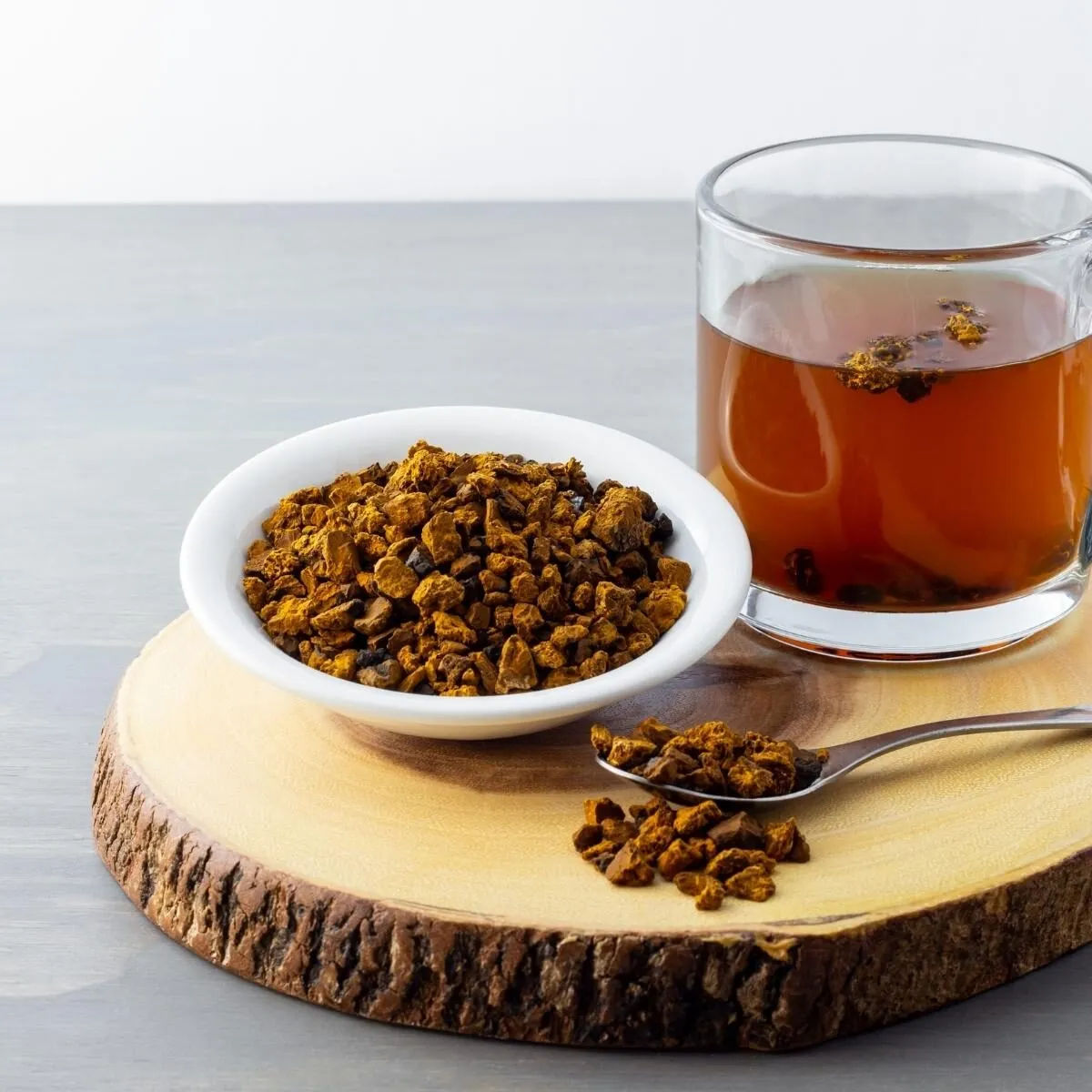
Chaga (Inonotus obliquus, if you want the Latin) is a fungus that grows on the bark of birch trees in cold places, and you’ll find it in Alaska, Canada, Scandinavia, Siberia, Russia and Korea. It forms a hard, cracked, charcoal-black growth called a conk, growing straight out of the bark. Looks more like forest rubbish than food, right? Crack one open, though, and the inside is a soft, orange-brown core, nothing like the burnt look on the outside.
Reliable information on chaga’s exact nutritional make-up is thin on the ground, but what’s known is that it’s low in calories, high in fibre, and loaded with antioxidants. You can read more in the research roundup on chaga’s uses and nutrition.
For centuries it’s been used as a traditional medicine in Russia and other parts of Northern Europe, mainly to support general immunity and wellbeing rather than treat anything specific. More recently it’s found its way into Western health shops, usually ground down and sold as a tea or supplement.
What the research actually says
Chaga has picked up a reputation online as a cure for nearly everything, from the common cold to cancer. That’s not what the evidence actually shows. Most chaga research so far has been done in mice or in test tubes, not in people, so treat every claim below as “early days,” not “proven.”
Immune system and inflammation
Animal and test-tube studies suggest chaga extract can support the immune system and calm long-term inflammation, partly by affecting white blood cells and the proteins (cytokines) that drive your immune response. In one mouse study, chaga extract reduced gut inflammation. It’s an interesting lead, not a guarantee it’ll do the same for you.
Blood sugar
Several animal studies link chaga to lower blood sugar. In one study, diabetic mice given chaga extract saw their blood sugar drop by 31% over three weeks. No human trials have tested this, so chaga isn’t something to use instead of insulin or diabetes medication. Talk to your doctor before changing anything there.
Cholesterol
Lab studies, mostly in rats, have found chaga extract lowers “bad” LDL cholesterol and raises “good” HDL cholesterol, which researchers put down to its antioxidant content. Promising, but still animal research, not human trials.
Cancer research and why chaga isn’t a treatment
This is the claim that gets the most overblown online, with blogs happy to suggest it cures practically everything. It doesn’t. Let’s be straight about it. Chaga is not a cancer treatment. What the lab research actually shows is that chaga extract has prevented or slowed the growth of cancer cells in test tubes, including liver, lung, breast, prostate and colon cells, and in one mouse study, chaga supplements led to a 60% reduction in tumour size. Researchers think the antioxidant triterpene in chaga is behind this. None of that has been tested in people. If you or someone you know has cancer, that’s a conversation for an oncologist, not a mushroom tea.
Allergies
A 2013 study in mice found that chaga mushroom extract reduced allergic and anaphylactic reactions and lowered IgE antibody levels. That’s the opposite of older claims you’ll see floating around that chaga itself “causes” allergic reactions. Again, it’s one mouse study, not proof it’ll calm your hay fever.

How people make and use chaga
C’mon then, here’s how it’s actually done. Traditionally, chaga is dried and ground into a coarse powder, then simmered in water for a chaga tea. It’s sometimes blended with other mushrooms, like cordyceps. Nowadays you’ll also find it as a loose powder or in capsules. There’s no agreed “correct” dose, because no one’s actually studied what a safe or effective amount looks like in people, so most sellers’ serving suggestions are their best guess, not medical advice.
Just as a side note, if you’ve only ever dealt with teabags, chaga looks more like a handful of woodchips than tea leaves, so don’t let the look put you off. If you like the idea of an earthy, slow-brewed cup but fancy something more widely available, have a look at what we’ve written about the benefits of oolong tea too.

Safety, side effects and who should steer clear
Short-term, chaga appears to be well tolerated, but there’s no proper human research on its long-term safety, so a few groups should be cautious:
- On insulin or diabetes medication. Chaga affects blood sugar, so check with your doctor first.
- Taking blood thinners, have a bleeding disorder, or have surgery coming up. Chaga contains a protein that affects blood clotting.
- Living with an autoimmune condition. Chaga may rev up immune activity, which isn’t what you want.
- Pregnant or breastfeeding. There’s no safety research here, so it’s safest to skip it.
Chaga supplements also aren’t regulated the way medicines are, so what’s actually in the packet isn’t checked the way a medicine would be. Buy from a seller who’s upfront about where theirs comes from. None of this is medical advice. If you’re on medication or managing a health condition, have a word with your doctor before trying chaga.
Where to buy chaga mushroom
Health-food shops and online retailers stock chaga as dried chunks, powder or capsules. Look for a seller who’s clear about where the chaga was harvested and how it was processed, and be wary of any label promising it’ll cure a specific illness. That’s a sign to shop elsewhere.
The bottom line
Chaga’s a genuinely interesting fungus with a long history and some promising early research behind it. It isn’t the cure-all it’s sometimes made out to be, and most of what we know still comes from mice and test tubes rather than people. Enjoy it as you would any herbal tea. Just don’t swap it for medication or medical advice. Right then, that’s chaga demystified. Brew it, enjoy it, and leave the miracle-cure talk to the adverts.
Chaga mushroom FAQ
Is chaga mushroom safe to drink every day?
What little research exists suggests it’s well tolerated short-term, but nobody’s studied daily, long-term use in people. If you’re on any medication, check with your doctor first.
Does chaga mushroom cure cancer?
No. Early lab and animal studies are promising, but there’s no human evidence, and chaga isn’t a cancer treatment. Don’t use it instead of medical care.
Who shouldn’t drink chaga tea?
People on blood thinners, with a bleeding disorder or upcoming surgery, with an autoimmune condition, who are pregnant or breastfeeding, or on diabetes medication should check with a doctor first.
How do you make chaga tea?
Simmer dried chaga chunks or chaga powder in water, then strain and drink. There’s no official dose. Just brew it to a strength you like.
Where can you buy chaga mushroom?
Health-food shops and online retailers sell it as chunks, powder or capsules. Pick a seller who’s clear about sourcing and skip any that promise a cure.

You might also love
More in Kitchen Tips & How-To
The Sunday Roast Timing Cheat Sheet (+ What to Prep the Day Before)
Updated: November 2, 2026 OK, Foodie Friends. A Sunday roast isn’t hard to cook. It’s hard to coordinate. Beef done, potatoes still…
Read
Healthy Recipes For Weight Loss And Muscle Gain
Updated: July 12, 2026 Introduction Achieving a healthy body composition with both weight loss and muscle gain is a common goal for…
Read
The Importance of Properly Storing Leftovers: Tips for Safe and Delicious Meals
Updated: July 12, 2026 From an unexpected second helping of mashed potatoes to the leftovers from a large family gathering, many have…
Read
How to Prepare a Mango (Slice, Score, and Fan in 90 Seconds)
Updated: November 7, 2026 To prepare a mango, stand it on end and slice straight down each side of the flat stone…
Read
Seasonal Foods In Summer
Updated: November 19, 2026 Summer’s the season when the kitchen basically runs itself. The days get longer, the stalls fill up, and…
Read
Balsamic Vinegar of Modena: The Heart of Emilian Tradition
Updated: July 12, 2026 Balsamic vinegar of Modena is one of Italy’s most precious gastronomic treasures, and in particular of Emilia Romagna…
Read